Research
A brief introduction to the research projects I'm currently working on!
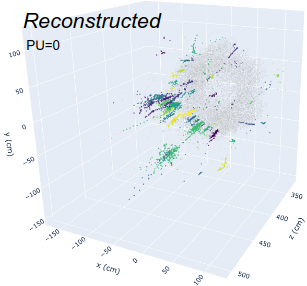
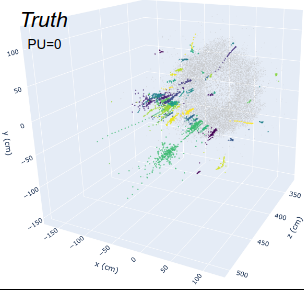
Hits in the HGCAL coloured by cluster — the network's reconstruction (top) against the simulation truth (bottom), at zero pile-up.
GNN-based end-to-end reconstruction in the CMS Phase 2 High-Granularity Calorimeter
The High-Granularity Calorimeter (HGCAL) is one of the most important upgrades to the Compact Muon Solenoid detector, built for the High-Luminosity phase of the Large Hadron Collider planned to begin operations in 2030, and reconstructing particles inside it means working out which of an enormous number of hits were left behind by the same particle. This work presents the first application of a one-pass, fully Machine Learning (ML) based imaging calorimeter reconstruction to the latest full CMS HGCAL simulation: a Graph Neural Network (GNN) that processes the calorimeter hits directly, trained to group the hits originating from the same incident particle into a common cluster, with no hand-written clustering rules involved. Performance is measured with physics-inspired metrics that quantify how accurately the properties of individual particles are recovered across different particle types. The study runs on zero pile-up simulations, so it does not yet reflect the conditions the detector will face, but it demonstrates that an end-to-end, ML-based reconstruction framework for the HGCAL is viable.
Paper: CMS Detector Performance Summary
Code: https://github.com/tklijnsma/cmspepr_hgcal_core
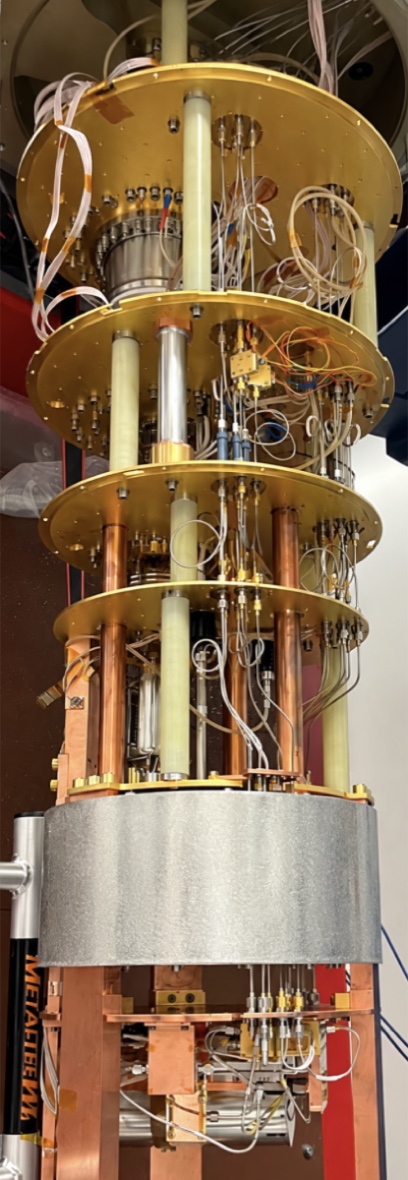
The NEXUS dilution refrigerator at Fermilab, where the qubit templates were measured.
Real-time detection of charge jumps in superconducting qubits using ML
Ionizing radiation from cosmic rays and gammas can knock the environmental charge of a superconducting qubit into a sudden, discontinuous jump, causing correlated errors that stand in the way of fault-tolerant quantum computing while simultaneously making the qubits themselves usable as particle detectors — but every established way of finding these charge jumps works offline, with far too much latency to feed back into qubit control. This work presents an online detector built on a dilated causal convolutional neural network (DCCNN), designed for in-the-loop deployment on the Quantum Instrumentation Control Kit (QICK) platform, trained on synthetic Ramsey tomography scans generated from qubit templates measured at the Northwestern Experimental Underground Site (NEXUS) at Fermilab and translated into FPGA firmware via hls4ml, reaching a per-inference latency of 6.19 μs on the Zynq UltraScale+ RFSoC ZCU216. It matches the detection efficiency of the established offline χ² algorithm while requiring no per-qubit hyperparameter tuning, turning charge-jump detection from a post-hoc diagnostic into a control-loop primitive.
Paper: arXiv:2607.14293