Projects
The three lines of research I'm currently working on!
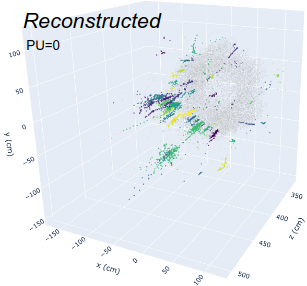
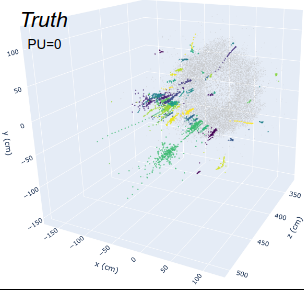
Hits in the HGCAL coloured by cluster — the network's reconstruction (top) against the simulation truth (bottom), at zero pile-up.
Physics-Constrained ML Across Experimental Modalities
Sparse detector patterns, qubit time series and evolving plasma measurements each demand models built around their own physical constraints. At CERN's CMS experiment I develop end-to-end reconstruction for the High-Granularity Calorimeter (HGCAL), an imaging detector that has to resolve particle showers amid roughly 200 overlapping collisions. My graph neural network enabled the first one-pass, machine-learning reconstruction study using the full CMS simulation. I am now developing an end-to-end reconstruction based on MaskFormers, whose learned queries predict a variable number of particles while masks associate the calorimeter hits with each one; MaskFormer reconstruction has improved jet-energy resolution by roughly 15% over a leading graph-based method, which motivates bringing it to CMS.
Related: CMS-DP-2026-057
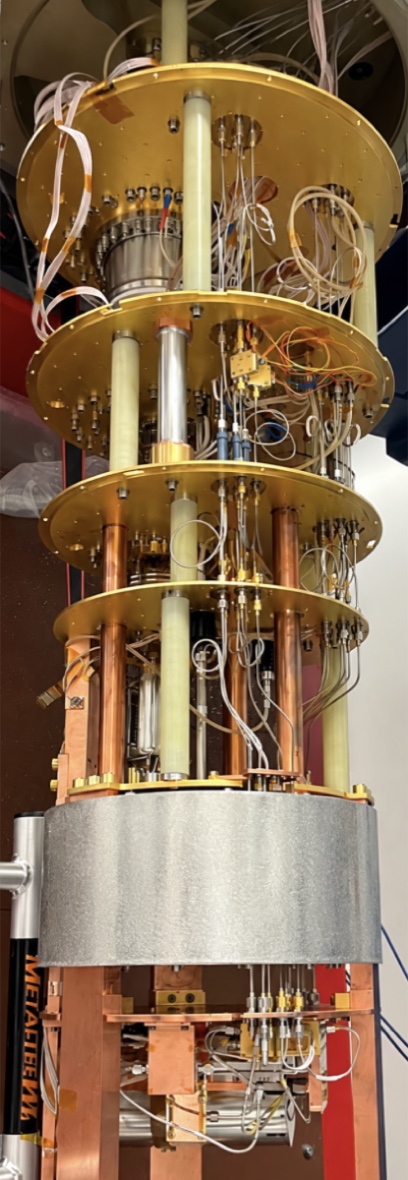
The NEXUS dilution refrigerator at Fermilab, where the qubit templates were measured.
Fast ML for Science
Many experiments need decisions in real time, which calls for fast ML: compact networks co-designed with the hardware that runs them for low-latency inference. I developed a convolutional neural network deployed on a Field-Programmable Gate Array (FPGA), a reconfigurable chip built for low-latency computation, that detects radiation-induced charge jumps in superconducting qubits within microseconds. I also collaborate with Jeff Schneider and researchers in Carnegie Mellon's Machine Learning Department on FPGA-accelerated plasma-state estimation for real-time tokamak control.
Related: arXiv:2607.14293 · Fast ML for Science 2026 talk
AI Agents for Complex Physics Analysis
My current analysis searches for collisions that produce four top quarks at once. The top quark is the heaviest known elementary particle, and a production rate that differs from prediction could point to phenomena beyond current theories. These events are exceptionally rare: the decay pattern I study can yield up to twelve quarks, yet only about one in 100,000 selected events is expected to contain the signal. Extracting it requires a tightly coupled workflow of distributed data processing, several ML models, backgrounds estimated from data and a joint statistical model, where a single change to particle reconstruction can ripple through event categories, background predictions and uncertainties, forcing the entire chain to be rerun and revalidated. That makes it an ideal benchmark for AI agents that must coordinate a complete scientific workflow rather than solve isolated coding tasks. I already use agents to navigate CMS software, diagnose distributed-computing failures, generate tests and trace dependencies, and I am building toward coordinated specialist agents that share analysis state, preserve context across long workflows and distinguish successful execution from physically valid reasoning, with human review of consequential choices.
Related: DPF 2026 talk